
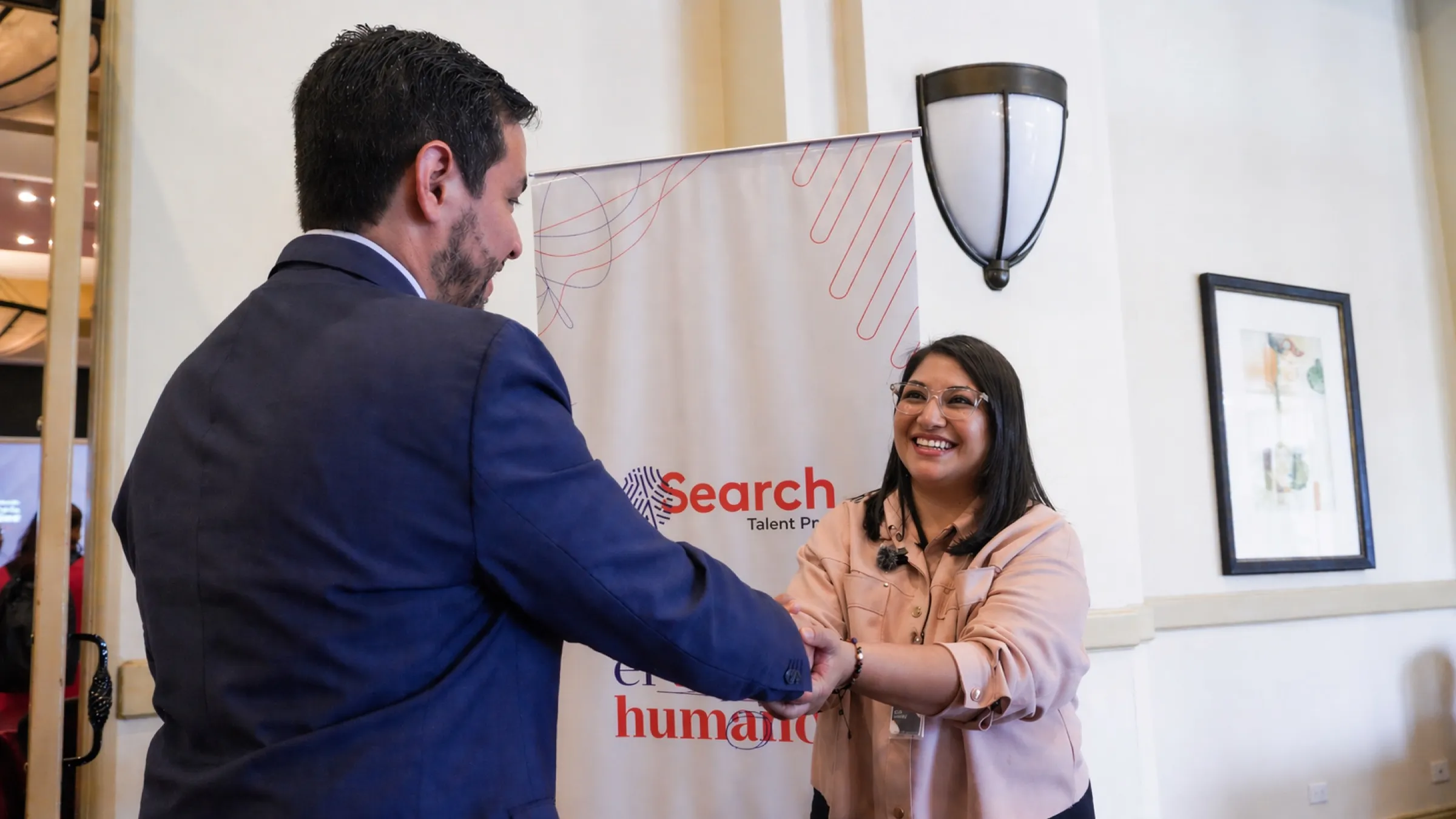
What Search Talent Pros’ Honduras Labor Market Study 2026 reveals
If you talk to a Honduran company, it will probably tell you it cannot find specialized talent. If you talk to a professional, they will tell you salaries fall short and hiring processes are opaque. Both describe the same market. Yet they almost never agree.
To understand that tension, at Search Talent Pros we surveyed companies and candidates in Honduras’ formal job market using two parallel versions of the same questionnaire. We measured six dimensions (compensation, market perception, hiring processes, work arrangements, soft skills and talent development) and set out a hypothesis for each one. The results were presented at the Honduras Human Resources Congress 2026.
The bottom line: of six hypotheses, five were confirmed and one was partially confirmed. These are the findings.
1. Salary: the one point everyone agrees on
It is no surprise, but it is a confirmation: salary is still the number one factor when accepting an offer. What is interesting is that companies and talent both identify it as the market’s main gap.
| Indicator | Companies | Talent |
|---|---|---|
| Point to low salaries as the main gap | 58.97% | 55.56% |
| Believe adjusting salaries would have the greatest impact | 48.72% | 59.06% |
| Importance of salary when accepting an offer (1–5) | 4.4 | 4.3 |
Source: Honduras Labor Market Study 2026, Search Talent Pros.
When both sides point to the same friction point, the signal is unmistakable. Talent, however, feels it more urgently: ten percentage points more.
2. The same market, read from opposite angles
When hiring, companies say they mainly face a shortage of specialized technical profiles (36%) and salary expectations beyond budget (31%). Only 13% mention strong competition for talent.
On the other side, almost half of candidates (48%) see that competition as a real obstacle. And a barrier appears that companies barely mention: 29% of talent feel that not mastering a second language closes doors for them.
Companies talk about a “lack of suitable talent”. Candidates talk about “unsuitable conditions and opaque processes”. It is the same market.
3. The most revealing finding: the silence after the interview
We asked both sides which stage of the hiring process causes the most frustration. The answers could not be more different.
| Stage | Companies | Talent |
|---|---|---|
| Lack of feedback | 12.82% | 65.50% |
| Candidate search / initial phase | 53.85% | 0% |
| Salary negotiation | 12.82% | 17.54% |
| Technical assessments | 10.26% | 4.09% |
| Interviews | 0% | 6.43% |
Source: Honduras Labor Market Study 2026, Search Talent Pros.
Companies place the bottleneck at the start: finding candidates. Talent experiences it at the end, not knowing what happened. 65.5% of candidates name the lack of feedback as their biggest frustration, something only 12.8% of companies register.
On duration there is relative agreement: most on both sides place the process at one to two months (42% of companies and 49% of talent). Companies, curiously, tend to perceive it as longer than the candidates themselves do.
4. Hybrid for everyone… but what about remote?
Here the hypothesis was only partly confirmed. The hybrid model is the broad consensus: 82% of companies and 64% of talent prefer it. There is even an unexpected nuance: candidates value working on-site (24%) more than companies think (18%).
The real gap is in remote work. 12.3% of talent prefer it; companies practically do not consider it (0%). It looks small, but it is not: Technology and Product is the area with the lowest preference for on-site work. Without remote options, Honduran companies compete at a disadvantage for the scarcest profile in the market, against global employers that do offer them.
5. Soft skills: finally, a match
This is the only finding without a significant gap. Companies and candidates agree on which skills matter: all scored between 4.38 and 4.62 out of 5.
| Skill | Companies | Talent |
|---|---|---|
| Effective communication | 4.62 | 4.56 |
| Teamwork | 4.55 | 4.55 |
| Adapting to change | 4.48 | 4.62 |
| Critical thinking | 4.42 | 4.58 |
| Leadership | 4.38 | 4.52 |
Likert scale 1–5. Source: Honduras Labor Market Study 2026, Search Talent Pros.
The difference lies in the order. Companies prioritize coordination skills (communication and teamwork), while talent puts adapting to change and critical thinking first.
6. Talent development: the clearest opportunity
This is probably the most actionable finding of the study. On one hand, talent is ready to learn:
- 96.4% would accept a role that requires initial learning if the company offers internal training.
- 79.5% consider it very important that the company invests in their professional development.
On the other hand, no company surveyed reports a high investment in development programs. Most (63.6%) invest moderately, without turning it into a strategy; a third report low investment.
Even so, something is changing. When the profile they are looking for does not fit the available salary, this is what companies do:
| Decision when a profile is not available | % of responses |
|---|---|
| Hire talent with potential and train them internally | 31.3% |
| Adjust the salary to the market | 29.7% |
| Keep searching for longer | 18.8% |
| Lower the required profile | 17.2% |
| Cancel or postpone the search | 3.1% |
Multiple-choice question. Source: Honduras Labor Market Study 2026, Search Talent Pros.
Hiring for potential is already, by a narrow margin, the most frequent answer. The model is emerging. What is missing is the systematic investment in training to back it.
Talent’s openness already exists. What is missing is the organizations’ training strategy.
Five actions companies can take today
The data point to concrete opportunities, some of them at no cost:
- Give feedback to every candidate, always. It costs nothing and answers talent’s biggest frustration (65.5%). It is the most obvious quick win for the employer brand.
- Audit and adjust salary bands. It is the action both sides ask for most (48.7% of companies and 59% of talent). It is worth seeing as an investment, not a cost.
- Launch a hiring-for-potential pilot. 20 companies already do it, and 96.4% of talent are willing to train.
- Evaluate remote work for technical profiles. The gap is small in volume but decisive for attracting the scarcest profiles.
- Set maximum times for each stage of the process. Speed, well managed, is a concrete competitive advantage.
The underlying question
The study suggests a change of focus. The challenge is not finding the perfect profile, but creating the conditions for available talent to grow inside organizations. Honduran talent is not waiting for the ideal job: it is waiting for someone to decide to develop it.
So the question is not whether talent is available. It is whether organizations are willing to develop it. Because the countries and companies that grew did not wait for the perfect profile. They built it.
About the study
Honduras Labor Market Study 2026, produced by Search Talent Pros from its own survey of companies and candidates in Honduras' formal job market. It included multiple-choice questions (up to two options), 1 to 5 Likert scales and additional questions on training and investment. Percentages correspond to each sample separately; comparisons between companies and talent are qualitative.